The considered sleep guide
Organic Mattress Certifications: What GOTS and GOLS Actually Tell You
A certification label can bring welcome clarity to an otherwise intricate mattress description. But GOTS and GOLS do not mean the same thing, and neither should be treated as a blanket guarantee about every material, component, or claim. Here is how to read the standards, ask sharper questions, and compare organic mattresses with confidence.
Published November 19, 2026
Shopping for an organic mattress can feel like entering a beautifully upholstered maze. One description highlights organic cotton; another mentions certified latex, natural wool, or a low-chemical finish. Then there are the letters: GOTS, GOLS, and sometimes additional certifications that address emissions, safety, or responsible sourcing. Each can offer useful information, but the details matter more than the number of badges on a product page.
The Global Organic Textile Standard, known as GOTS, is a textile-processing standard. The Global Organic Latex Standard, or GOLS, is designed for organic latex products. They concern different materials and stages of production, so one does not substitute for the other. A mattress might use latex certified to GOLS and a cotton cover or wool batting certified to GOTS; those claims point to separate parts of its construction.
Understanding that distinction is a practical first step. The next is to find out exactly what is certified, who certified it, and whether the available documentation relates to the finished product or only to one ingredient. A thoughtful label reading is less about collecting acronyms and more about matching a specific claim to a specific material.
What GOTS means
GOTS sets requirements for textiles made with organic fibers and for the processing stages that turn those fibers into textile products. Depending on the product claim and applicable standard requirements, that scope can include steps such as processing, manufacturing, packaging, labeling, and trading. It also includes criteria related to environmental management and certain social conditions in the supply chain.
In other words, GOTS is not simply a statement that a cotton plant was grown organically. It is intended to provide a framework for tracking organic textile material through a defined chain of processing and handling, while setting requirements for how participating facilities operate. The precise certification claim and the version of the standard in force matter; readers should consult the standard and certification records for the current details rather than assuming every GOTS claim covers every stage in the same way.
GOTS is relevant to mattress textiles such as cotton fabric, textile covers, and certain wool components when they are within the scope of the certification. It does not, by itself, certify a latex core. Nor does a GOTS certificate for a fabric automatically mean that the entire mattress, including its foam, adhesives, zipper, fire barrier, or foundation, is GOTS certified.
What GOLS means
GOLS addresses organic latex products. It sets requirements for the organic status and traceability of latex materials, as well as processing conditions and other aspects of production. It can help shoppers distinguish a certified organic latex claim from a broad description such as “natural latex,” which is not the same thing as certification.
For a mattress, the latex may be used as one or more supportive or comfort layers. A GOLS claim should prompt a useful follow-up: does it refer to the latex core or layers, or is the company claiming certification for the finished mattress under the relevant scope? A mattress may contain GOLS-certified latex while also including other materials that are not covered by GOLS. That does not make the latex claim meaningless; it means the claim should be read at the level it actually describes.
As with any certification, the standard’s current requirements and the certificate’s scope are decisive. Ask for the name of the certifier and a current certificate or other verifiable documentation. If a brand states a percentage or describes a component as “100% GOLS-certified,” clarify what that wording refers to: the latex content, a particular layer, or the entire product. Specific language is more useful than an expansive-sounding label without context.
GOTS versus GOLS at a glance
| Question | GOTS | GOLS |
|---|---|---|
| What does it address? | Organic textile fibers and relevant textile processing and supply-chain requirements. | Organic latex products and relevant latex processing and traceability requirements. |
| Which mattress parts might be relevant? | For example, qualifying cotton textiles or wool components, depending on the certified scope. | Qualifying latex layers or cores, depending on the certified scope. |
| Does it automatically certify the whole mattress? | No. Check which textile component and supply-chain activities are included. | No. Check whether the claim covers latex components or the finished product. |
| What should a shopper request? | The precise certified material, certificate details, and scope relevant to the product. | The precise latex component, certificate details, and scope relevant to the product. |
The word “organic” is not the whole story
“Organic” can describe a material, a product category, or a production claim, and those meanings are not interchangeable. A mattress described as organic might contain certified organic cotton or latex but also include other materials that are not certified organic. A retailer may also use “natural” to describe a material without claiming that it meets an organic standard.
Look for nouns as carefully as adjectives. “GOTS-certified organic cotton cover” is more specific than “organic mattress.” “GOLS-certified latex core” tells you which part the certification concerns. By contrast, a general statement that a mattress is “made with organic materials” leaves unanswered which materials, what proportion of the construction they represent, and whether the claim is independently verified.
Certification also does not tell you everything about comfort or suitability. It cannot determine whether a mattress feels too firm for your pressure preferences, whether its support is right for your body, or whether it will work with your bed frame. Those questions call for construction details, dimensions, a clear explanation of feel, and careful consideration of your own needs.
A label-reading checklist for mattress shoppers
Before you compare prices or settle on a particular construction, use this checklist to turn a broad marketing claim into a series of answerable questions:
- Identify the certified component. Is the claim about the cotton cover, wool batting, latex core, or complete mattress?
- Ask what the certificate covers. Does the documentation name the material, product, facility, or relevant supply-chain activity?
- Check who issued it. Request the certifier’s name and current certificate information. Look for documentation that can be verified, not just a logo reproduced on a product page.
- Separate verified claims from general language. “Natural,” “eco-conscious,” and “clean” do not necessarily mean a material is certified organic.
- Read the full bill of materials where available. Ask about latex, textiles, wool, adhesives, fire barriers, coatings, thread, and any other components the brand discloses.
- Check the wording against the product itself. A certificate or claim for a material supplier does not automatically establish that every part of the finished mattress is certified.
- Review practical details. Find out whether the cover is removable, how the mattress should be cleaned, what foundation it requires, and how the warranty handles impressions or other wear.
These questions are not an exercise in suspicion. They are a way to make meaningful comparisons. Two mattresses can both use the word “organic” while differing significantly in certified materials, construction, care requirements, and disclosure. Specific answers let you understand what you are buying without expecting a single certification to tell the entire story.
Why certification scope matters
Certification relies on defined scopes and records. A standard may apply to particular materials and operations, and the company’s certification status may relate to certain facilities or products rather than everything it sells. That is why a product-page badge should be treated as a starting point, not as the complete evidence behind a claim.
When reviewing documentation, look for the certificate holder, the certifier, the products or materials listed, and the certificate’s validity. If the product is made from several layers, compare the documentation with the brand’s description of those layers. If the certificate is for an ingredient or a processing facility, ask how that connection is established for the mattress you are considering.
Supply chains can include many separate businesses. Fibers may be grown in one place, processed elsewhere, and assembled into a mattress at another facility. Standards use chain-of-custody and related requirements to support traceability within their scope. The practical takeaway is simple: the more precise the claim, the easier it is to evaluate. If the information is unclear, a brand should be able to explain what its certification does—and does not—cover.
Certifications are not the same as performance guarantees
A certified material is not automatically more comfortable, more durable, or more suitable for every sleeper than a non-certified alternative. Those are separate questions. Latex, for example, can vary by formulation, firmness, thickness, and design. Cotton and wool textiles differ in weave, quilting, density, and care instructions. A well-informed purchase considers these characteristics alongside sourcing and processing claims.
Durability depends on the design of the whole mattress, the quality and thickness of its components, how it is supported, and how it is cared for. A long warranty can be reassuring, but it is not a prediction that every mattress will feel unchanged for its full term. Read what counts as a covered defect, whether body impressions are addressed, and what support surface is required.
Likewise, organic certification is not a substitute for examining safety or emissions information. If you are concerned about a specific chemical, coating, or product emission, ask about that subject directly and look for documentation addressing it. Certifications have particular scopes; a shopper should not infer a broader health or environmental conclusion than the standard supports.
A real-world example: reading a layered latex mattress claim
Consider a mattress described as having a GOLS-certified organic Dunlop latex core, a cotton cover, and wool quilting. The claim about the core is distinct from the claims about the textiles. The next step is to establish whether the cotton and wool are certified under GOTS, whether that certification covers the relevant components, and whether the finished mattress is represented as certified or simply as containing certified materials.
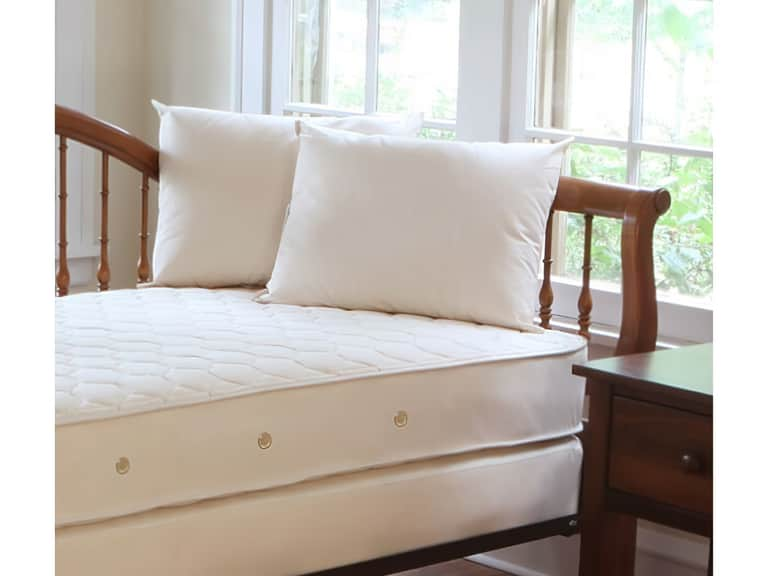
For example, the Obasan Deluxe Dunlop Latex Mattress is described as using GOLS-certified organic Dunlop latex and a cotton cover quilted with GOTS-certified organic wool. Those descriptions point to different materials and standards. A shopper comparing it with another model should still review the current product documentation, construction details, care instructions, foundation requirements, and warranty rather than treating either label as a complete assessment of the mattress.
This is the distinction that makes certification literacy useful: it allows you to acknowledge a verified material claim without stretching it to cover parts of the product it does not name. The aim is neither to dismiss certification nor to mistake it for a universal seal of approval. It is to understand what the evidence can reasonably tell you.
How to compare organic mattresses beyond the badge
Once you have clarified certification, turn to the mattress itself. Start with the layer-by-layer construction. Note the thickness and firmness of latex layers, whether the design is zoned, and what materials sit above and below the core. For hybrids, identify the spring system and comfort layers. For all-foam designs, ask what types of foam are used and how the layers are arranged.
Then consider how the mattress will fit your sleep and home. A label cannot tell you whether a particular feel will work for your sleeping position or pressure preferences. Trial terms, exchange fees, delivery arrangements, mattress weight, and return logistics may influence the decision just as much as the composition. Ask whether the mattress can be used on an adjustable base, what kind of foundation is recommended, and whether there are spacing limits for slats.
Care requirements deserve equal attention. Some mattress covers are removable but not washable; others should be spot-cleaned only. Latex should be protected from moisture and handled according to the manufacturer’s instructions. A mattress protector may help guard against spills and everyday wear, but check that it fits properly and does not conflict with the maker’s care guidance. Clear instructions are part of the product, not an afterthought.
Questions to ask a retailer or manufacturer
If a product description leaves gaps, a concise inquiry can help. You might ask:
- Which exact materials in this mattress are certified to GOTS or GOLS?
- Does the certification apply to an individual component, a facility, or the finished mattress?
- Can you provide the current certificate details and the name of the certifying body?
- What materials are used in the remaining layers, cover, fire barrier, and assembly?
- Are there specific cleaning, rotation, or foundation requirements that affect the warranty?
- What are the trial, return, and exchange terms, including any costs?
Clear answers should be specific without being evasive. A retailer may need to confirm details with the manufacturer, but it should be able to explain the difference between certified materials and broader product-level language. If a claim remains vague after a reasonable request, compare it with another product whose construction and documentation are easier to understand.
The most useful way to think about GOTS and GOLS
GOTS and GOLS can make organic mattress shopping more legible, particularly when a product contains both textile and latex components. GOTS is relevant to qualifying organic textiles and their processing; GOLS is relevant to qualifying organic latex products. Each offers a framework for evaluating particular materials and parts of a supply chain, subject to the standard’s requirements and the scope of the relevant certification.
Neither label, on its own, tells you that every mattress component is organic, that the mattress will suit your body, or that it will last for a particular number of years. A smart comparison brings together the certificate, the layer list, the support and comfort design, the care instructions, and the warranty. It also distinguishes a verified claim from the softer language that often surrounds it.
The result is a more composed kind of shopping: less dazzled by a single word, more attentive to the materials and evidence behind it. Ask what is certified, verify the scope, and judge the whole mattress on its construction and practical fit. That is how a label becomes genuinely useful—not as a shortcut around research, but as one well-defined part of it.
Quick takeaway
GOTS concerns qualifying organic textiles and their processing; GOLS concerns qualifying organic latex products. Both can inform a mattress comparison, but certification scope matters. Verify which component is covered, review the rest of the construction, and consider comfort, care, support, and warranty before deciding.